A modern classroom is no longer defined only by books, blackboards and rows of desks. Today, technology can make lessons more visual, interactive and connected. However, meaningful education still begins with something technology cannot replace: a teacher who understands a child. The real value of modern education lies not in how much technology a school uses, but in how thoughtfully it uses technology to support curiosity, creativity and deeper understanding.
As one of the best ICSE schools in Hooghly District, Vision International School recognises the importance of maintaining this thoughtful balance between technological advancement and meaningful human connection in education. The school follows a healthy amalgamation of traditional methods and modern techniques. This creates an educational environment where technology complements classroom teaching instead of taking away from the human connection at its heart. This approach also allows students to explore new ideas while continuing to benefit from guidance, interaction and personal attention.
This blog sheds light on how modern classrooms can embrace technology thoughtfully while preserving the relationships, creativity, values and personal guidance that make school education truly meaningful.
The Ways to Create a Modern Classroom with a Human Core
Modernisation should not mean filling every classroom with screens. It should mean choosing the right tools to help children understand concepts better, explore ideas confidently and participate actively. Vision International School follows this broader approach through an environment that combines academic learning with technology, practical exploration and co-curricular development. Here’s how this balanced approach can make modern learning more meaningful, engaging and student-centred.
• Technology That Supports Teachers, Not Replaces Them
A key part of modernising classrooms is choosing technology that supports teachers. A digital presentation can explain a difficult concept visually, while an interactive resource can encourage students to explore it further. However, a teacher still provides context, asks meaningful questions and notices when a learner needs additional support.
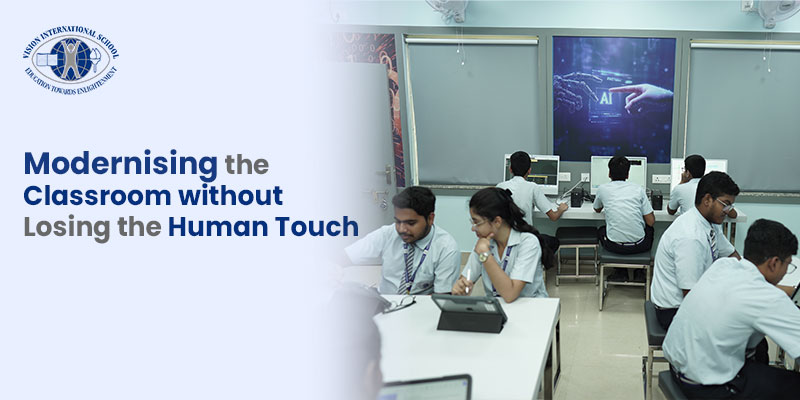
At Vision International School, facilities such as computer laboratories, the AI & Robotics Lab and the Apple Innovation Centre & iMac Project Lab create opportunities for technology-enabled learning. These resources work best when teachers use them as extensions of thoughtful classroom instruction rather than as substitutes for it.
• Empowering Teachers Through Expertise and Continuous Learning
Technology is only as effective as the teacher who uses it. At Vision International School, well-qualified and well-equipped teachers combine subject expertise, innovative teaching practices and a deep understanding of learners to create meaningful classroom experiences. Their ability to adapt, guide and inspire ensures that technology remains a tool for learning-not a replacement for the teacher’s role. Through continuous professional development and collaborative learning, teachers remain equipped to respond to evolving educational needs while keeping every child’s learning experience personal and purposeful.
• Turning Technology into Active Learning
The strongest technology-led classrooms move children from passive viewing to active participation. Instead of simply watching a video about a scientific process, students can investigate it, discuss their observations and apply their understanding through a project.
Vision International School’s facilities support this kind of experiential approach. Its Science Laboratories, Mathematics Lab, AI & Robotics Lab and computer facilities provide spaces where concepts can move beyond the textbook and become practical experiences.
• Keeping Conversation at the Heart of Learning
Keeping conversation at the heart of learning is another significant aspect of creating a modern, future-ready learning space. Even the most advanced classroom needs conversation. Students learn to express ideas when they discuss, debate, question and collaborate with others. These interactions also develop communication, empathy and confidence.
Vision International School reinforces this human side of education through activities such as debate, drama and elocution, cultural programmes, exhibitions and club activities. Such experiences can complement academic learning by giving students opportunities to listen to others, present their ideas and work as part of a community.
• Using AI with Curiosity and Responsibility
Artificial intelligence is becoming an important part of modern education, but students need more than technical familiarity. They also need critical thinking, judgement and an understanding of responsible technology use.
Vision International School already integrates AI into its educational ecosystem through its AI & Robotics Lab, and it also offers Artificial Intelligence within its ISC programmes across Science, Commerce and Humanities. This gives students opportunities to understand emerging technology while continuing to develop broader academic and human skills.
• Protecting the Joy of Being a Student
A truly modern classroom should leave room for creativity, movement, discovery and relationships. Children should not spend their entire school day interacting with devices when they could be experimenting, performing, playing or talking with classmates.
Vision International School’s 3.5-acre campus, two-acre sports ground, multi-activity halls, Music & Dance Studio and open green spaces reflect a wider idea of education that extends beyond the screen. Its curriculum and activities bring academic learning, physical development, creativity and values together.
• The Vision International School Approach to Future-Ready Education
The future of education does not belong to technology alone. It belongs to schools that understand when technology adds value and when human connection matters more. Vision International School brings these two elements together through a thoughtful blend of ICSE and ISC academics, specialised learning facilities, practical experiences, well-equipped teachers and value-based education.
This balanced approach demonstrates how a school can embrace modernisation while keeping students, their development and their individual learning experiences at the heart of education.
The Closing Thoughts
Modernising the classroom is ultimately not about choosing between technology and tradition. It is about bringing the best of both together. At Vision International School, “Education Towards Enlightenment” reflects this larger purpose: preparing learners to create, innovate and apply knowledge while developing the values and human qualities they need beyond school.
Are you seeking a future-ready English-medium school in Hooghly that values both innovation and meaningful human connection? Vision International School offers an education designed for the world ahead without losing sight of what makes learning deeply human. So why wait? Connect with us for more information.