Knowing the answer is important, but knowing how to apply it truly makes a difference. In a rapidly changing world, education must go beyond textbooks, classroom discussions and examination scores. Children need opportunities to apply what they learn, solve everyday problems and develop skills that help them face real-life situations with confidence. This shift from simply acquiring information to developing practical skills has become increasingly important in today's changing educational landscape.
The early years of education play an important role in shaping a child's curiosity, communication and problem-solving abilities. Parents considering nursery class admission should therefore look for a school that encourages children to explore, interact and learn through meaningful everyday experiences. A supportive learning environment during these formative years can help children develop confidence, creativity and a positive attitude towards education.
According to the World Economic Forum's Future of Jobs Report 2025, 69% of surveyed employers identify analytical thinking as a core skill. Creative thinking, resilience and technological literacy also feature among the most important skills. These findings highlight the importance of preparing students to think independently and apply their knowledge effectively.
This blog explains how practical learning turns academic knowledge into real-world capabilities, why this approach matters for today's students, and how Vision International School encourages a balanced approach to education through modern facilities and diverse learning opportunities.
Why Should Education Go Beyond Textbooks?
Traditional classroom teaching provides children with the foundational knowledge they need to understand different subjects. However, real learning begins when students discover how to use that knowledge outside the classroom.
For example, understanding mathematical calculations is useful, but applying them while managing a budget makes the lesson more meaningful. Similarly, learning scientific concepts becomes more interesting when students can observe experiments and understand how things work. This approach can help children develop:
- Critical Thinking: Analysing information and making sensible decisions.
- Problem-Solving: Finding practical solutions to everyday challenges.
- Communication: Expressing thoughts clearly and listening to others.
- Creativity: Exploring different ways to approach a task.
- Adaptability: Responding confidently to new situations.
These abilities encourage students to become independent learners who can apply their knowledge in different situations.
How Can Schools Turn Knowledge into Practical Capabilities?
A well-rounded education should provide students with opportunities to explore, experiment and participate in meaningful activities. Here are some important ways schools can connect academic learning with real-life experiences.
Learning Through Experiments and Practical Activities
Science becomes much more interesting when students can test ideas instead of simply memorising definitions. Experiments can help children observe results, understand processes and learn from mistakes.
Vision International School provides well-equipped science laboratories where students can explore scientific concepts through practical activities. Its mathematics lab also offers opportunities to understand numerical concepts through interactive learning.
Such experiences can nurture curiosity and help students connect theoretical concepts with practical applications.
Building Technological Confidence Through Innovation
Technology continues to transform how people work, communicate and solve problems. Therefore, students need more than basic computer knowledge; they must learn to understand and use technology responsibly.
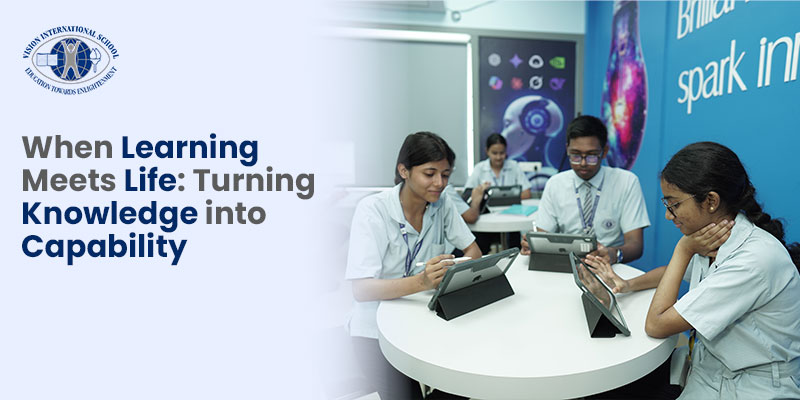
Vision International School features an Apple Innovation Centre and iMac Project Lab, along with an AI and Robotics Lab. These facilities provide students with opportunities to explore digital tools, understand emerging technologies and strengthen their logical thinking.
Learning about robotics, for instance, can introduce children to coding, sequencing and problem-solving. It also encourages them to think creatively while working towards a solution.
Developing Leadership Through Group Activities
Real-life situations often require people to work together, share responsibilities and respect different opinions. Group activities help students develop these qualities early on.
Whether students participate in classroom projects, group discussions or inter-school competitions, they can learn to communicate their ideas and contribute to a common goal. These experiences can gradually build leadership, teamwork and decision-making abilities.
Connecting Physical Education with Life Skills
Education should develop both the mind and the body. Sports and physical activities teach children valuable lessons about discipline, patience, teamwork and resilience.
Vision International School provides dedicated sports and games facilities, giving students opportunities to participate in physical activities alongside their academic commitments. Playing team sports can also teach children how to handle challenges, respect rules and accept both success and failure with a positive attitude.
Encouraging Creativity and Self-Expression
Not every valuable ability develops through academic lessons. Music, dance, cultural activities and creative projects allow students to discover their interests and express themselves.
Vision International School has a music and dance studio and a multi-activity hall that support opportunities beyond the conventional classroom.
Such activities can help children build confidence, appreciate different forms of expression and explore their individual talent.
Vision International School: Creating Opportunities for All-Round Development
Established in 2008, Vision International School follows the ICSE and ISC curriculum and focuses on providing a balanced school education. Its approach combines traditional teaching methods with modern educational techniques.
The school's 3.5-acre campus, 88,000-square-foot built-up area and dedicated 2-acre sports and games ground provide an environment where students can participate in different academic and extracurricular activities.
From science laboratories and technology-based learning facilities to sports and creative spaces, the school offers several opportunities for students to explore their interests and develop useful abilities.
The aim is to help children understand that education is not limited to what they learn for examinations. It is equally about how they use that knowledge to make informed decisions, overcome challenges and contribute positively to society.
Closing Thoughts
The true value of education lies in its ability to prepare children for life. When students combine academic knowledge with practical experience, they can become more confident, capable and independent. At Vision International School, modern learning facilities, academic guidance and opportunities for extracurricular development support this broader vision of education. Give your child the opportunity to learn, explore and grow with Vision International School. Connect with us today to learn more about lower nursery admission at Vision International School and give your child an opportunity to learn, explore and grow in a supportive educational environment.